Geena Davis Rejects Legacy of ‘Male Bashing’ Accusations in Reflection on 'Thelma & Louise'
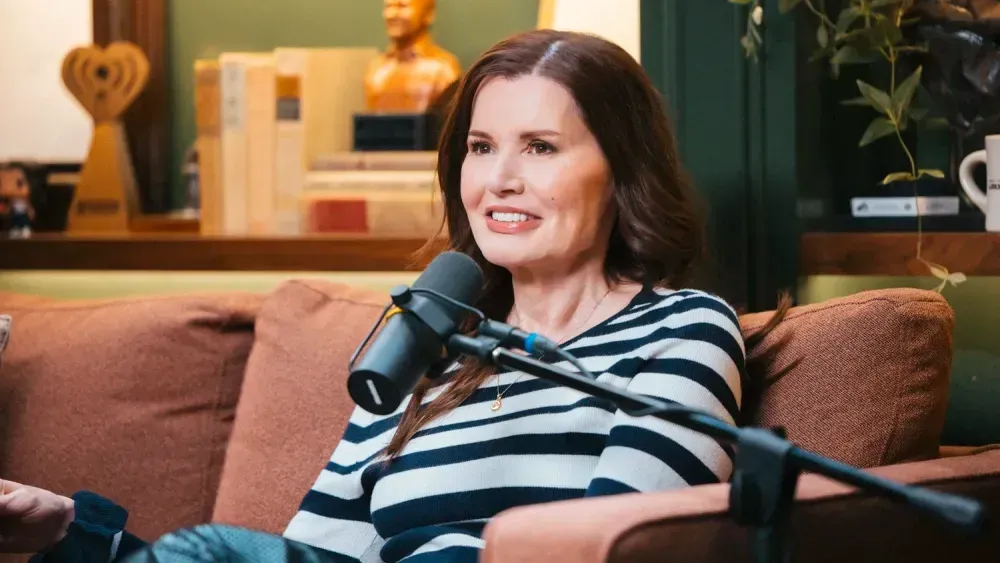
Photo Credit: Armchair Expert Pod
by Chris Tremblay Jul 22
3 MIN READ
In an interview released on July 20, 2026, on the Armchair Expert podcast , actor and advocate Geena Davis reflected on the polarizing reception of the 1991 feminist landmark Thelma & Louise . Speaking with hosts Dax Shepard and Monica Padman, Davis described the "firestorm" that erupted shortly after the film’s release, which saw major media outlets and critics leveling accusations of misandry and "male bashing" against the production .
Davis specifically recalled the shock of seeing the film featured on the cover of Time magazine just one week after its debut, accompanied by two separate editorials that denounced the movie as a "horrible idea" . According to Davis, the critiques were rooted in a profound discomfort with female characters who refused to relinquish control over their own destinies .
A central theme in the contemporary backlash was the depiction of women using guns. Davis noted that many reviewers at the time were "horrified" by the visual of Thelma and Louise—played by herself and Susan Sarandon, respectively—wielding firearms . Critics claimed this sent a "horrible message," ignoring the established cinematic tradition of male "outlaw" characters doing the same .
Davis and Sarandon have frequently pointed out the statistical disparity in how violence was perceived in the film compared to male-centric action movies of the early 90s . Davis referenced a historical comparison made by Entertainment Weekly that tracked the number of bullets fired in Thelma & Louise versus Lethal Weapon . Despite the significantly lower body count and violence in the Ridley Scott-directed film, the fact that women were the ones pulling the trigger provoked a visceral reaction from some male critics .
During her 2026 podcast appearance, Davis challenged the notion that the film was anti-male, a defense she has maintained for over three decades . She pointed out that the movie features seven significant male characters, ranging from the supportive Detective Hal Slocumb to the manipulative J.D. .
Davis argued that the "male bashing" label was a reductive way for critics to dismiss a story that centered female friendship and autonomy . Screenwriter Callie Khouri, who won an Academy Award for the script, has also expressed her past shock at being labeled "neo-fascist" by critics such as John Leo for depicting a woman shooting an attempted rapist . Khouri famously remarked that critics were "completely taken aback" by the idea of a woman retaliating against violence, even when the violence against the woman was the catalyst for the entire plot .
The overwhelming reaction from women in the audience, which stood in stark contrast to the critical backlash, profoundly changed Davis's approach to her career . She noted that seeing women feel empowered and energized by the film made her realize how rarely such opportunities existed in Hollywood .
This realization eventually led to the founding of the Geena Davis Institute on Gender in Media , which uses data-driven research to address unconscious bias and improve the representation of women and other marginalized groups, including transgender people, in entertainment . Davis noted in a May 2026 interview that while gender parity has improved in children's television, the broader industry still struggles with meaningful representation for various identities .
Davis's recent reflections come as she promotes her latest project, The Boroughs, a Netflix series that pays homage to her iconic role in Thelma & Louise . The series includes visual cues, such as a vintage convertible, that nod to the 1991 film's imagery .
The enduring cultural power of the film was further cemented in early 2026 when Davis appeared at the Coachella Valley Music and Arts Festival during Sabrina Carpenter’s set . In a pre-recorded skit, Davis and Sarandon played older versions of Carpenter and her backup dancers, performing a sequence that echoed the "outlaw" spirit of their most famous roles .
Despite the "male bashing" accusations and the "horrible idea" editorials of 1991, Thelma & Louise has transcended its initial controversy to become a cornerstone of feminist cinema . Davis remains firm in her stance that the film did not "bash" men, but rather exposed the fragility of certain societal norms regarding female behavior .
"People really liked it and it did well," Davis noted on the Armchair Expert podcast, pointing out that the film earned nearly three times its budget at the box office despite the "ruckus" caused by critics . Today, the film is revered not for its supposed "horrible message," but for its uncompromising depiction of women who choose freedom over subjugation, even at the highest possible cost .
The 'Horrible Message' of Armed Women
A central theme in the contemporary backlash was the depiction of women using guns. Davis noted that many reviewers at the time were "horrified" by the visual of Thelma and Louise—played by herself and Susan Sarandon, respectively—wielding firearms . Critics claimed this sent a "horrible message," ignoring the established cinematic tradition of male "outlaw" characters doing the same .
Davis and Sarandon have frequently pointed out the statistical disparity in how violence was perceived in the film compared to male-centric action movies of the early 90s . Davis referenced a historical comparison made by Entertainment Weekly that tracked the number of bullets fired in Thelma & Louise versus Lethal Weapon . Despite the significantly lower body count and violence in the Ridley Scott-directed film, the fact that women were the ones pulling the trigger provoked a visceral reaction from some male critics .
Challenging the 'Man-Hating' Narrative
During her 2026 podcast appearance, Davis challenged the notion that the film was anti-male, a defense she has maintained for over three decades . She pointed out that the movie features seven significant male characters, ranging from the supportive Detective Hal Slocumb to the manipulative J.D. .
Davis argued that the "male bashing" label was a reductive way for critics to dismiss a story that centered female friendship and autonomy . Screenwriter Callie Khouri, who won an Academy Award for the script, has also expressed her past shock at being labeled "neo-fascist" by critics such as John Leo for depicting a woman shooting an attempted rapist . Khouri famously remarked that critics were "completely taken aback" by the idea of a woman retaliating against violence, even when the violence against the woman was the catalyst for the entire plot .
Impact on Representation and Career Choices
The overwhelming reaction from women in the audience, which stood in stark contrast to the critical backlash, profoundly changed Davis's approach to her career . She noted that seeing women feel empowered and energized by the film made her realize how rarely such opportunities existed in Hollywood .
This realization eventually led to the founding of the Geena Davis Institute on Gender in Media , which uses data-driven research to address unconscious bias and improve the representation of women and other marginalized groups, including transgender people, in entertainment . Davis noted in a May 2026 interview that while gender parity has improved in children's television, the broader industry still struggles with meaningful representation for various identities .
Modern Homages and The Boroughs
Davis's recent reflections come as she promotes her latest project, The Boroughs, a Netflix series that pays homage to her iconic role in Thelma & Louise . The series includes visual cues, such as a vintage convertible, that nod to the 1991 film's imagery .
The enduring cultural power of the film was further cemented in early 2026 when Davis appeared at the Coachella Valley Music and Arts Festival during Sabrina Carpenter’s set . In a pre-recorded skit, Davis and Sarandon played older versions of Carpenter and her backup dancers, performing a sequence that echoed the "outlaw" spirit of their most famous roles .
Conclusion: The Verdict of Time
Despite the "male bashing" accusations and the "horrible idea" editorials of 1991, Thelma & Louise has transcended its initial controversy to become a cornerstone of feminist cinema . Davis remains firm in her stance that the film did not "bash" men, but rather exposed the fragility of certain societal norms regarding female behavior .
"People really liked it and it did well," Davis noted on the Armchair Expert podcast, pointing out that the film earned nearly three times its budget at the box office despite the "ruckus" caused by critics . Today, the film is revered not for its supposed "horrible message," but for its uncompromising depiction of women who choose freedom over subjugation, even at the highest possible cost .
Copyright EDGE Media Network. All rights reserved. This material may not be published, broadcast, rewritten, or redistributed.