Jordan Stephens Reflects on the Queer People Who Shaped His Childhood
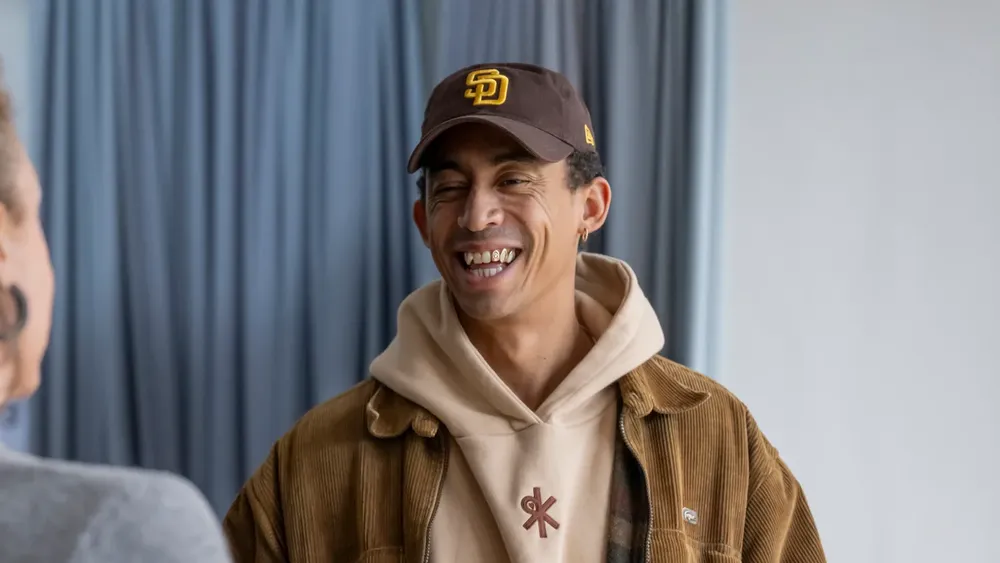
STOKE-ON-TRENT, ENGLAND - OCTOBER 14: In this image released today, Jordan Stephens talks to Rachel Adams the Director of Appetite, a project working to get more people in Stoke-on-Trent to experience and be inspired by the arts, receiving additional funding from The National Lottery on October 14, 2025 in Stoke-on-Trent, England.Photo Credit: Anthony Devlin
Jordan Stephens says his connection to the LGBTQ+ community grew from the people around him as a child, rather than from a later decision to become a public ally. In an interview published by Attitude on November 3, the musician and actor credited his mother, Emma Boulting, with bringing a diverse group of people into his life. “My compassion and curiosity and admiration for the queer community definitely stems from the people that my mum had around me as a child,” he said.
Among the people he remembers is his godfather, musician David McAlmont, whom Stephens has previously described as “an incredible gay Black man with a beautiful voice.” Stephens recalled visiting McAlmont’s home, where McAlmont lived with his partner, Bill. The profile reports that Bill has since died.
Stephens also recalled McAlmont’s collection of Barbie dolls. “And again, as a boy, I didn’t think that was weird,” he said. In the interview, he described the people around him as coming from “all shapes, sizes, races, genders, proclivities,” adding that their identities were not the first thing he thought about when he remembered them.
Role models and everyday fairness
The profile links Stephens’s memories of McAlmont not only to personal affection but also to an early awareness of unfair treatment. Stephens recalled that McAlmont had faced pressure in his music career to sing about being in a heterosexual relationship. “I remember even as a child being, like, ‘That doesn’t seem fair,’” Stephens said. He recalled feeling a “sense of injustice” on McAlmont’s behalf.
Stephens’s recollection presents queer role models as part of his family and social world, rather than as distant public figures. The interview does not frame his childhood as a formal lesson in allyship; instead, it records his account of relationships that helped shape his perspective. His description of McAlmont and the other people around him centers their place in his life and the influence he says they had on him.
A Metro interview published on October 14 offers independent context for Stephens’s broader reflections on role models. In that interview, he said he felt complicated about being seen as one, and credited “interesting, insightful, loving women” with providing much of his strength, creativity and guidance. He also rejected the idea that positive role models for men must necessarily be men.
The Metro conversation focused on women’s safety, masculinity and public perceptions of allyship, rather than on the childhood memories discussed in the new Attitude feature. Together, the interviews show Stephens describing formative influences across different relationships: the queer adults in his childhood and the women he says guided him as he grew up.
Looking back at language used in school
The interview also includes Stephens’s account of behavior he now regrets. He said that while at secondary school in Hove, he used “gay” as an insult, describing it as a habit tied to wanting to fit in. “I’m hoping that my stances as an adult are kind of somewhat restorative in that way,” he said.
Stephens said that his language at the time was not limited to sexuality, and described the behavior as “assimilation.” The interview does not set out a specific act of repair; the word “restorative” appears in his own reflection on the contrast between his past conduct and his present positions.
The account adds a note of complexity to a profile otherwise focused on the influence of queer people in his life. Rather than describing his childhood as a straightforward story of understanding, Stephens acknowledges that he also adopted language that could demean LGBTQ+ people. His stated hope is that his adult stances can, in some way, address that earlier behavior.
A public conversation about allyship
Stephens’s comments arrive after a period of public discussion about his relationship with the LGBTQ+ community. In October, Attitude reported that he received its 2026 Ally Award and quoted him crediting former partner Jade Thirlwall with showing him what an ally is. That coverage also described his participation in the Trans Mission Live fundraiser earlier in the year.
In the newer interview, however, Stephens’s account reaches further back than his adult advocacy or relationships. He points to the people his mother brought into his childhood, and to McAlmont in particular, as influences on his sense of fairness and his admiration for queer people. The interview records his own memories and interpretation; it does not claim that one experience alone explains his views.
Attitude’s November/December issue excerpt therefore offers both a personal account of formative queer role models and Stephens’s acknowledgment of past mistakes. His remarks about McAlmont’s career and his own school language put attention on two different experiences: the unfairness he says he noticed as a child, and the hurtful language he says he later used to fit in.
Copyright EDGE Media Network. All rights reserved. This material may not be published, broadcast, rewritten, or redistributed.