Reed Birney Defends Transgressive ‘Blue Film’ Performance as Career-Best Work Amid Sustained Industry Backlash
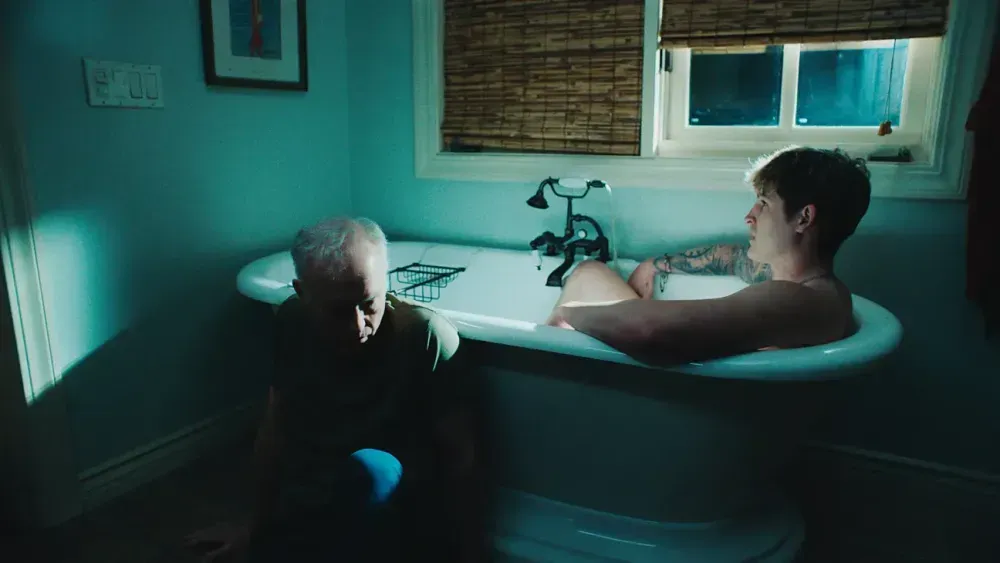
Photo Credit: Obscured Releasing
In a career spanning over four decades and decorated by a Tony Award, Reed Birney has become one of the most respected character actors in American theater and television. However, it is his most "radioactive" role to date—portraying a convicted sex offender in the micro-budget indie thriller Blue Film—that the actor now identifies as his defining professional achievement . Speaking in a comprehensive feature published on July 22, 2026, Birney addressed the intense divisiveness surrounding the film, which has faced a tumultuous path from production rejections to a cult theatrical following .
A "Radioactive" Premise and the Path to Distribution
Directed and written by Elliot Tuttle in his feature debut, Blue Film was produced on a shoestring budget of under $100,000—with some reports citing a figure as low as $50,000 . The narrative is a tense, two-handed chamber piece that unfolds almost entirely within the confines of a Los Angeles Airbnb . Birney stars as Hank Grant, a 71-year-old former middle-school English teacher who recently completed a seven-year prison sentence for the attempted sexual assault of a student .
The plot is set in motion when Hank hires a hypermasculine fetish camboy and sex worker named Aaron Eagle, played by Kieron Moore , for a private session . The encounter takes a dark turn when Aaron realizes that his client is actually his former teacher and that the evening has been meticulously engineered by Hank to force a confrontation regarding their shared past .
The film's unflinching, non-judgmental lens on Hank's psyche made it an "arthouse hot-potato" during its 2025 festival run . It was famously rejected by major platforms including the Sundance Film Festival and SXSW, largely due to concerns over its provocative subject matter . After a successful premiere at the Edinburgh International Film Festival in late 2025, the movie struggled to find a distributor for months before being acquired by the newly formed Obscured Releasing .
Birney’s Creative Investment and Defense
Despite the significant backlash—which has included accusations that the film is "irresponsible" for centering the perspective of a predator—Birney remains steadfast in his support of the project . "I have such a huge emotional investment in the movie, not only because I am playing this difficult role and I feel it's the best film work I've ever done, but I also really collaborated with Elliot on it," Birney stated . Birney, who also served as an executive producer, noted that he and Tuttle spent several months refining the script together before filming began .
The actor’s approach to the character of Hank Grant was one of psychological complexity rather than villainous caricature. Birney explained that he "never for a second thought of Hank as a monster," but rather as a "sad and broken man" . This empathetic portrayal has been a primary source of the film’s controversy, as some critics argue it risks humanizing a person who committed irredeemable acts .
Addressing the visceral reactions from audiences, Birney acknowledged that the film is "too loaded" for some, particularly those who have experienced sexual abuse or trauma . "You meet the movie where you can... if you've had trauma or sexual abuse, you're not going to be generous towards Hank," he admitted . However, he expressed disappointment over the inability of some viewers to separate his performance from the actions of the character, noting that for many, this film is their first introduction to his work .
Global Reach and Continued Momentum
While Blue Film has remained a divisive topic in the United States, its momentum is growing internationally. On July 13, 2026, Peccadillo Pictures announced that the psychological thriller would receive a wide theatrical release in the United Kingdom and Ireland on September 25, 2026 . This follows a strategy of targeted screenings in U.S. cities like New York, where the film has played at venues such as the IFC Center and BAM to sold-out audiences .
The film’s stars have characterized their audiences as "fearless," praising those who are willing to engage with such transgressive material . During a SAG-AFTRA Foundation conversation on July 2, 2026, Birney and Moore discussed the "cult life" the film has already taken on since its initial U.S. opening .
Journalistic Context: A Career Defined by Nuance
For Birney, the success and the scandal of Blue Film represent a significant shift in his professional trajectory. Having long been a staple of the "prestige" television landscape—with notable roles in House of Cards and The Americans—and a theater veteran who won a Tony for The Humans, Birney described this project as the "biggest thing that's ever happened" to him professionally .
"It was very gratifying to see, 'Yeah, Reed, you can play a big part. You can carry a movie,'" he reflected . While the film continues to draw blood from its critics, Birney’s performance has been widely cited as a fearless masterclass in character study, forcing audiences to confront uncomfortable truths about human brokenness and the complexities of survivor-perpetrator dynamics .
As Blue Film moves into its digital rental phase and prepares for its European debut, the conversation surrounding Reed Birney’s "best work" remains as charged as the film itself .
Copyright EDGE Media Network. All rights reserved. This material may not be published, broadcast, rewritten, or redistributed.