EDGE Interview: Building a Living Library: Taylor Mac on Queer History, Joy, and 'Bark of Millions'
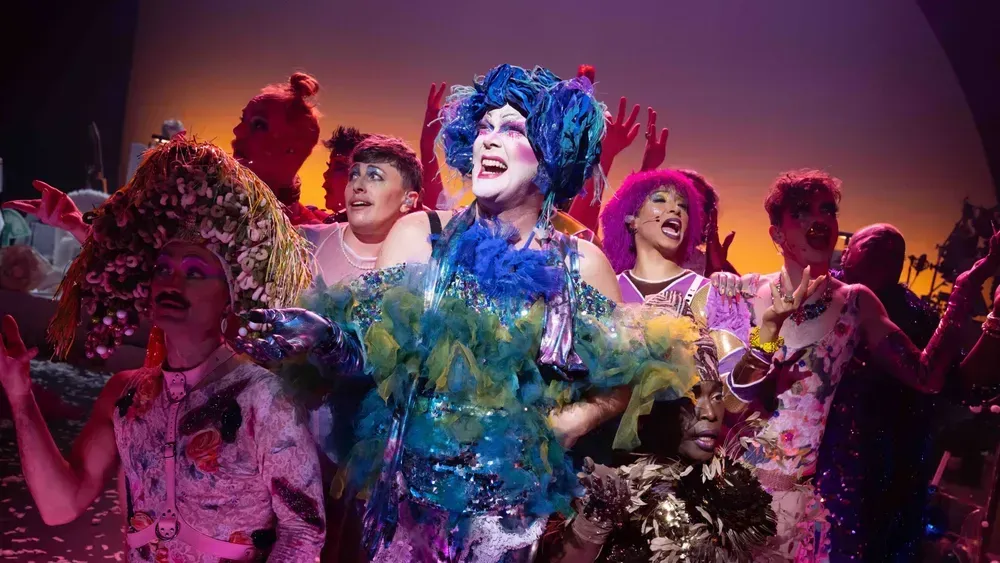
Photo Credit: Julieta Cervantes
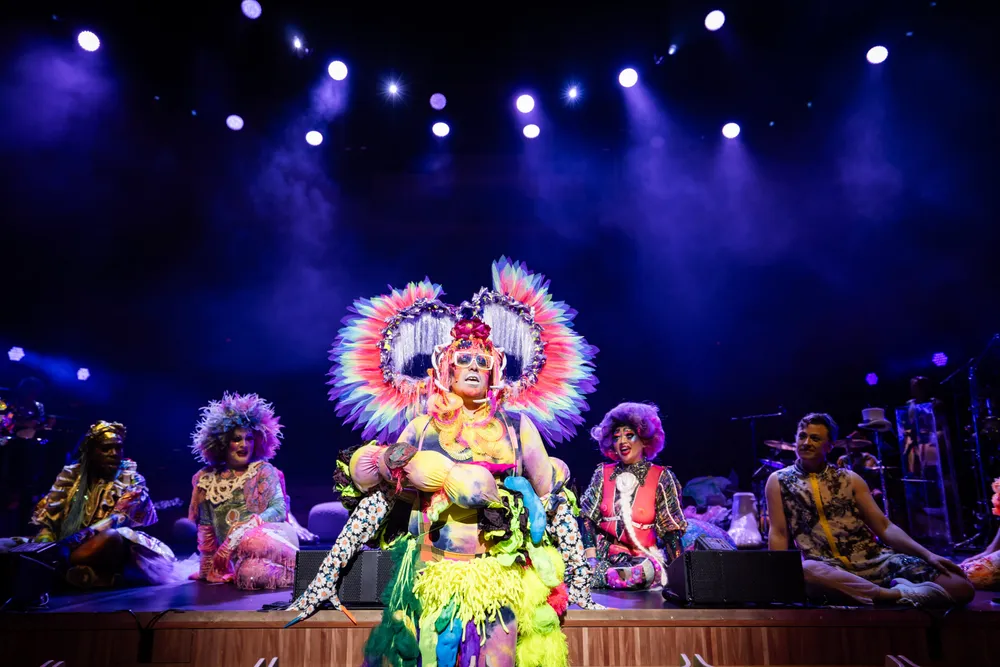
Imagine a stage bursting with music, drag, and queer history. In Bark of Millions, acclaimed collaborators Taylor Mac and Matt Ray reunite for a dazzling concert event that celebrates the people, stories, and legacies that have shaped queer life across generations. Performed by a powerhouse ensemble of 17 artists, the show transforms original songs into a vibrant spectacle of live music, movement, stunning visuals, and Machine Dazzle's unforgettable costumes. Part concert, part theatrical event, and part community celebration, Bark of Millions invites audiences of all identities to gather, connect, and revel in an evening of joy, individuality, and shared humanity. As Bark of Millions travels from stage to stage, carrying its songs, stories, and celebration of queer life, Taylor Mac took a moment to discuss the ideas and inspirations fueling the project.
TM: Well, I had done a show called A 24-Decade History of Popular Music, a durational performance art concert where I sang 240 songs from the American canon. What I realized through performing all of those songs was that very few of them, maybe three, were actually intended for queer people. A lot of them were written by queer people, but most were created through a heterosexual, cisgender lens.
When I finished that project, I realized that my whole life, I had been listening to the radio and translating almost every song I heard into a queer experience. There have been centuries of omission, erasure, and oppression that have required queer people to constantly stretch themselves toward the dominant culture. And I thought, let me do my bit to change that.
So I called up Matt Ray and asked if he would make a new show with me where we would write many, many, many songs inspired by queer people throughout world history. We started with 50 songs, and now we're up to 57, although the book includes the first 50.
At its heart, the project is an attempt to heal a little bit from all that omission and to explore what queerness is, simply to wonder about it through song. One thing I've learned from being a singer is that songs help us understand our humanity. So, if we're missing all of these songs about queerness, are we also missing a big part of who we are?
The Daughters of Bilitis had a mission to add to what they called "the living library of the deviant theme." And I thought, Yeah, that's what I want to do. I want to be part of that effort, to add to that living library and hopefully inspire other people to do the same.
As far as I know, in the history of songbooks, there has never been a queer songbook published by a major publisher. That's kind of unfathomable to me, although, given the history of queer erasure, I suppose it also makes sense. I've looked, and I haven't found another one. So it's shocking that this may be the first.
EDGE: You’ve described the work as responding to the omission and erasure of queer people from history. Did you discover a particular person or story while creating the show that completely surprised you?
TM: I mean, a lot. Some of the people are world-famous, like Audre Lorde or Oscar Wilde, and some are simply the queen down the street who I happen to know, meet, or encounter. I wasn't approaching this as a historian. I leave that to the historians. And I wasn't really thinking of it as representation, either. I don't even know how to represent myself in a song, let alone another person or an entire demographic.
What I wanted was for the songs to be acts of wondering about queerness, about queer spirituality, courage, defense, trauma, love, and community. That was really the larger exploration.
And yes, I discovered things about people I've known for most of my adult life, everything from something simple they once said to how they died, who they loved, or what they had to keep secret. But I also discovered people and stories I had never encountered before.
One of the people who inspired a song is Shwe Shue in Myanmar, who is genderqueer. She runs a beauty parlor in a small shack, and it has essentially become a community center for queer people. People from Yangon come to her little shack to hang out and have created this safe place for themselves. It's quite remarkable.
It's hard to say whether this exploration helped me find her story or whether life brought the story to me and then the song was inspired by it. I don't necessarily know which came first. But that's the kind of story that so many people simply don't know about.
We also recently wrote a song inspired by Area Scatter, a Nigerian woman who was assigned male at birth. According to her story, she went into the woods or jungle one day and emerged as a woman, and the town blessed her, believing it was a great blessing from the earth. That feels incredibly profound, particularly when you consider the realities queer people face in Nigeria today.
So, yes, I'm constantly discovering things about these figures, these people, and even these myths. Some of the songs are inspired by queer mythology. I also didn't know about Tu'er Shen, the Taoist deity associated with same-sex love. I even visited Tu'er Shen's temple in Taipei and spoke with the people who run it.
It's fascinating to discover how much is out there for us to explore, consider, and wonder about.
EDGE: With so many queer figures and stories to choose from, how did you decide whose lives would inspire songs?
TM: Well, one of the things I've always said is that this is an open-ended project. This is Volume One, and maybe in 20 years we'll publish Volume Two. And then maybe we'll pass it on to somebody else to continue. There really is no end to the project because all of the songs are inspired by different queer people from throughout world history, and that's an enormous well to draw from. The more historians teach us about these people and bring their stories to light, the more songs there are to be written.
The idea was never for the project to end, and that actually freed me from having to ask, Who's more important? Whose story needs to be told? Instead, we can simply follow the people and stories that inspire us.
And sometimes that's someone like Donald Gallagher, this queen who lives down the street from me and has a rainbow beard. He's just a delight. Every time he walks into a room, you know you're in the right place because everyone's face lights up. He's simply a wonder.
So we wrote a song inspired by Donald because it's fun to do that, too, to celebrate the people who may not be famous historical figures, but who light up a room and bring joy to the people around them.
EDGE: Has creating Bark of Millions changed the way you think about your own place within queer history?
TM: I've started to think differently about my role in all of this. I've brought together so many people for this show; maybe 30 people are involved now. And with Matt Ray, my main collaborator who wrote all the music, we've been collecting these extraordinary humans and bringing them into our lives and our work for many years.
For the first time, I've started to think of myself as a kind of drag mother. I'd never really thought of myself that way before, but I've realized one of the great joys of my life is seeing magic in the world and wanting to share it with other people.
And that's really part of what this project is about. It's about seeing all of this queer magic and wanting to share it. So much of queer history is ignored, overlooked, or maybe reduced to a meme or a passing reference. It's rarely given the time and space of the human voice or turned into song.
Songs become part of the fabric of our lives. We learn them in school, grow up with them, and they help shape how we understand the world. If none of those songs are about queerness, then we don't even realize that an entire piece of that fabric is missing.
So, if I leave a legacy, I hope it's that I contributed well. I hope I was someone who saw something magical and knew how to share it with other people. At least, I hope so.
We'll see. Or I won't see, but the world will.
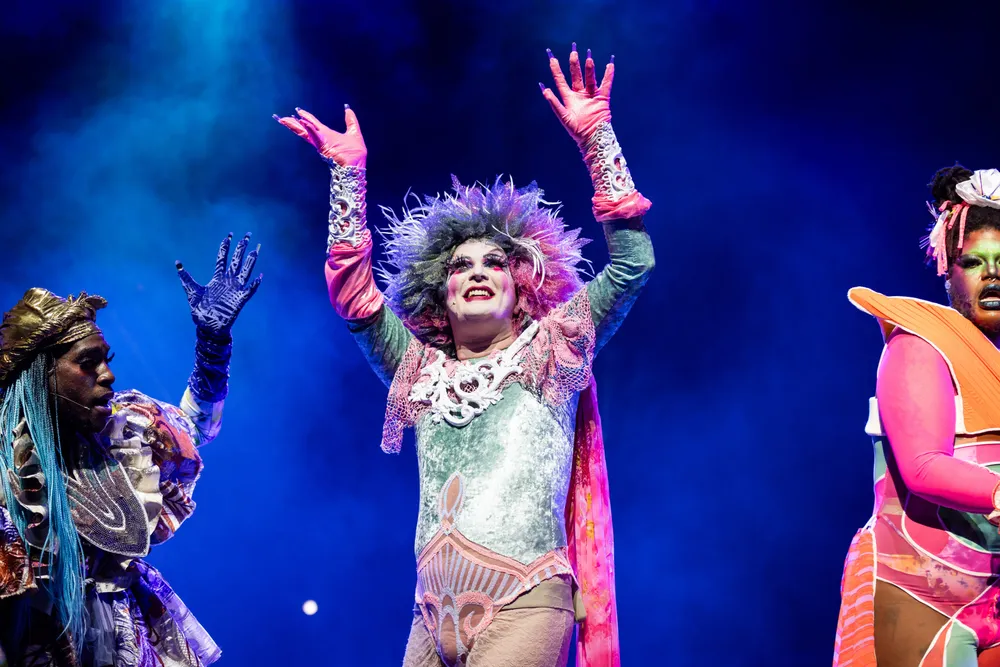
EDGE: Drag is central to the visual and theatrical language of this production. What can drag communicate that conventional theater sometimes cannot?
TM: That's an interesting question. I've always thought of drag as theater because, in many ways, the ancient Greeks were basically in drag. They performed in heightened costumes, masks, and platform shoes, creating these larger-than-life figures onstage. The Elizabethans were certainly performing across gender as well. So I've always thought of drag as part of the tradition of theater.
I think that, over the last couple of centuries, we've gotten a little bit away from that. Theater became more restrained and naturalistic. To me, drag isn't necessarily doing something beyond what theater can do. It's actually a return to the roots of what theater is. It's a reminder that we're on a stage to expose and heighten parts of our humanity and, quite literally, to reach the back row.
Drag does that incredibly well. Drag reaches the back row. It includes the person who is farthest away because it's larger, heightened, and theatrical. But over the years, drag was often relegated to basement bars and small spaces. In those intimate venues, it can almost seem overwhelmingly large because it doesn't need that scale to reach the audience.
That's why I think it's so interesting to put drag into an amphitheater like the Delacorte or somewhere as grand as the Sydney Opera House, where we've performed the show. In spaces like those, drag feels like it's back in its natural element. It's bigger than television. It wants to be in the large theater.
What's fascinating about this moment is that drag is more visible than ever. But I also wouldn't say that something like Arthur Miller isn't drag. It's simply a different kind of drag, a more controlled and restrained form of theatricality. That kind of performance might belong beautifully in a black box theater because it doesn't need the same scale to reach the back row.
For me, that's really the point: drag doesn't stand outside the theatrical tradition. It reminds us how big, bold, and heightened theater has always been able to be.
EDGE: There is something wonderfully defiant about putting queer joy onstage. Do you think joy itself can be a form of protest?
TM: Absolutely. I've seen it over and over again in my life. There are moments when you feel like you're being torn apart, and yet somehow you bring yourself back together. Part of that is simply choosing to exist, choosing not to disappear. And existing means allowing yourself to experience all of the emotions, including joy.
I really believe that what you practice is what you become. If you practice pain, tragedy, and anger all the time, then that's what you become. So you have to practice joy as well, so that you can become it. I mean, look at Dolly Parton's life. You have to practice joy.
And when you find joy, I think it's important to put it out into the world. That doesn't mean ignoring pain, anger, tragedy, or all the other parts of life. It's more about deciding to make those things the side dish. What do you want for your main course?
Frankly, I'd rather it be joy.
And there is something powerful, even defiant, about that. Choosing joy can defeat the people who want tragedy to consume everything. We see that happen over and over again. Joy becomes a way of saying, I'm still here, and I'm not going to disappear.
EDGE: You’ve now collaborated on extraordinarily ambitious projects with Matt Ray, including A 24-Decade History of Popular Music and Bark of Millions. What does each of you bring out creatively in the other that might not exist when you're working separately?
TM: Well, I don't know what I bring out in Matt that might not otherwise exist, but I do know what he brings out in me. I think I'm much more cynical than Matt is. Even though he's the New Yorker and I'm the one from California, I probably have more biting irony in me than he does.
Maybe part of that comes from how we were raised. He grew up in an East Coast culture where you say what you're feeling when you're feeling it, whereas I grew up in a culture where you hide what you're feeling and bring it out later. I don't want to psychoanalyze him, but I do feel like he's connected to a kind of sweetness that I'm always reaching for.
His music is deeply emotional, and I'm always reaching for that sweetness but don't necessarily get there on my own. Then you add his music, and it's just this perfect fit. His music takes me that extra step toward the emotional place I'm trying to reach. I think that's primarily what he brings to my work.
And maybe the opposite is true of what I bring to his. I'm always carrying around the complexity of anger, sorrow, trauma, and all those harder truths. Perhaps that helps balance out a certain sense of pure love or sweetness in his work. We meet somewhere in the middle, and that's where the work becomes complete.
EDGE: Are there parts of queer history that you believe are still routinely left out even when we talk about LGBTQ+ history today?
TM: It's a complicated question because, in many ways, everything gets wrapped up in capitalism. To share work and put it out into the world means participating in that system, and capitalism has a tendency to flatten things, flatten bodies, perspectives, and experiences so they can be consumed by the masses. The qualities that make us unique- our quirks, our humor, our rhythms- can easily become commodities simply through the act of being seen.
I don't think we talk enough about how authenticity is slowly eroded in the process of surviving, finding visibility, and making our presence known. We're constantly trying to figure out how to exist in the world without losing ourselves.
The songs in this project are part of my response to that challenge. This isn't really a commercial endeavor. Of course, I hope people buy the book, but I'm never going to make millions from it. What matters to me is the idea that these songs might live in people's homes and communities. That's something different. It's not commercial in spirit or in sound. It's your voice, not mine. The book invites readers to contribute to the Living Library and join that ongoing conversation.
Because of that, the project feels communal rather than transactional. I hope I've found a way for the work to spread without being diminished by its own dissemination. Ultimately, that's the question I'm most interested in: How do we tell our stories without destroying them in the process? It's a big question, and one I'm still exploring.
EDGE: Bark of Millions asks audiences to look backward while also imagining a queer future. What can younger LGBTQ+ people gain from knowing the generations who came before them?
TM: I was just saying that last night I got to perform with André De Shields, this legendary Broadway performer. When I first came to New York City and saw André onstage back in 1993, I felt like I was seeing home. He's two generations ahead of me, and something about seeing him made me feel like I was experiencing a kind of home I so rarely get to feel.
I think part of that is because most queer people don't necessarily grow up with queer parents. The way our parents interpret the world, or the ways they expect us to behave within it, can make us feel different. Even when someone isn't literally kicked out of their home, there can still be these little kicks that make you feel as though some part of you doesn't completely belong.
So when you see a queer elder, or discover someone from the past and learn about their life, it can feel like coming home. It's a way of saying, Oh, yes. We do belong here. We've always belonged here.
We're often told that queerness isn't natural, but when you look at nature, nothing is perfectly ordered. Everything is curved, varied, and constantly changing. The idea of a perfectly straight line is something we've imposed upon the world. And when I think about sexuality and gender in that way, something begins to make sense. When people say queerness isn't natural, what they're often expressing is a desire to control something that doesn't fit neatly within the boundaries they've created.
Queerness is natural. It's part of the extraordinary variation of the natural world, even though people have spent centuries trying to control it.
And that's what learning about your past can give you. You can look back at the people who came before you and say, “This has always been here. This is part of the natural world. This is home.”
EDGE: If there is one message you hope audiences take away from this experience, what would it be?
TM: In terms of the book, I think the relationship changes over time. I hope people reconnect with it throughout their lives. You might learn a song, put the book back on the shelf, then return to it a year later to discover something new, share it with friends, or inspire someone else to pick it up. I love the idea of it becoming an ongoing meditation that evolves with you.
As for the show, I often say on stage that it's a reverse conversion therapy session. I hope everyone leaves a little queerer than when they walked in.
For more information about Taylor Mac, visit https://taylormac.org/, and to purchase tickets to Bark of Millions, visit www.barkofmillions.com
Copyright EDGE Media Network. All rights reserved. This material may not be published, broadcast, rewritten, or redistributed.