Harry Styles Turns Gym into Disco Fever Dream in ‘Dance No More’ Video
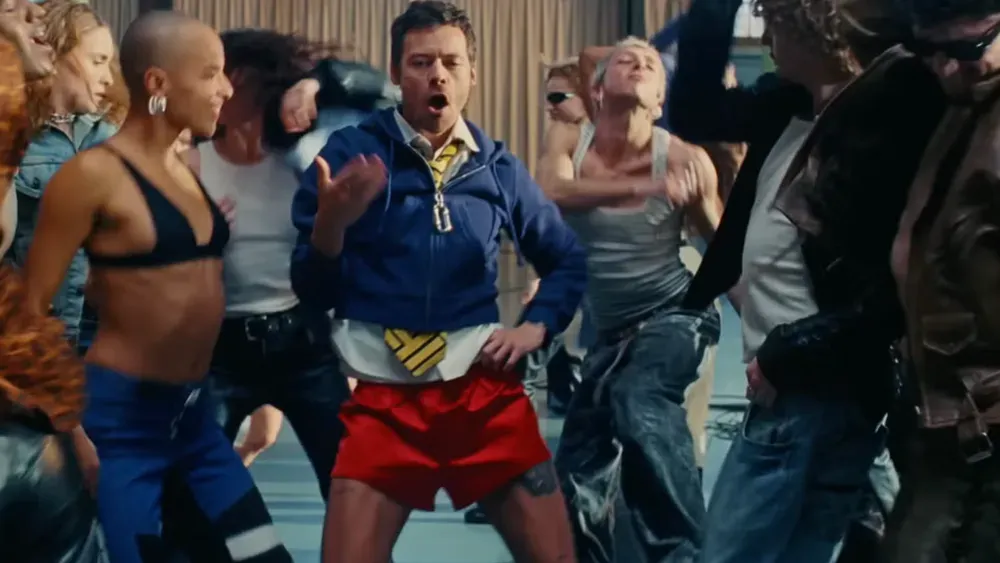
Photo Credit: Columbia Records / YouTube
by Chris Tremblay May 8
5 MIN READ
In the new “Dance No More” music video, Harry Styles opens in what appears to be a school gymnasium, walking toward a live band and an audience seated politely in rows as if at a school assembly, before grabbing the microphone and beginning to sing. As the track builds, the once-still crowd gradually sheds their reserve, crawling toward the stage and eventually spilling into a full-tilt disco, where dancers of various genders pair off to kiss and move together as the gym morphs into a nightclub-style dance floor.
The video, directed by Colin Solal Cardo, leans into high-energy choreography, featuring Styles fronting more than two dozen dancers and executing one of the most dance-focused performances of this album era. While early moments nod to the awkwardness of a school function, the clip quickly pivots into a glossy, liberated dance spectacle that underscores the song’s insistence that music can dissolve boundaries between performer and audience.
Visually, much of the online conversation has centered on Styles’ wardrobe and physical performance, including a now-viral moment where he licks the microphone mid-walk, a teaser image he used to announce the video’s release on May 6 for its May 7 premiere at 12 p.m. EST. Styles appears in a custom Marc Jacobs ensemble, including red short shorts that recall 1970s gym kits, a cropped blue hoodie, and layered tailoring pieces he gradually strips down from blazer and sweatshirt to a tank and shorts as the room’s energy intensifies.
Commentators have highlighted the choreography’s focus on hip work, spins, and playful, suggestive moves, with one New Zealand-based write-up describing Styles “shaking his ass all throughout the three-minute and twenty-second video” and calling the combination of the red shorts, microphone lick, and butt-centric moves enough to leave viewers “feral.” That piece also frames the group kissing sequence at the end—where couples of varying genders lock lips amid the crowd—as “a pretty iconic display of love and freedom,” positioning the clip as a celebration of romantic and physical expression that includes LGBTQ+ viewers and fans without sensationalizing them.
Lyrically, “Dance No More” explores the tension between being the performer whose music drives the party and the person who simply wants to join everyone else on the dance floor, a dynamic that multiple interviews and analyses have underlined. ELLE notes that the song is written from the performer’s point of view, with Lines such as “Move it side to side with your hands up high / Keep your customer satisfied and live your life” and “It’s feeling like the music has been heaven sent / And that there’s no difference in between the tears and the sweat” framing the stage as both workplace and spiritual site.
In a BBC Radio 1 discussion earlier in the year, Styles explained that the central phrase “‘DJs don’t dance no more,’ they said” originated with a friend named Chloe, who remarked on how unusual it felt for a DJ to be dancing with friends on the floor instead of remaining elevated behind decks. He further told Apple Music’s Zane Lowe that the “no difference between the tears and the sweat” lyric came from his own experience in a Berlin club, where he stood in the middle of the dance floor feeling “so unbelievably free and safe” that he closed his eyes, raised his hands, and cried while dancing, describing it as a moment of feeling “so alive.”
“Dance No More” is the third music video from Styles’ fourth studio album, *Kiss All the Time. Disco, Occasionally*, which was released in March and debuted at No. 1 on the Billboard 200, becoming his fourth consecutive chart-topping album and moving 430,000 equivalent album units in its opening frame, according to Variety. The album’s disco-infused sound and themes span fame, loneliness, and nightlife, with “Dance No More” singled out in several pieces as a celebration of dance floor “salvation” and the joy of communal movement.
The rollout began with lead single “Aperture,” whose video depicted Styles evading an aggressive stalker, followed by “American Girls,” which featured film-set stunts including a car sliding under a truck and a motorcycle launch. “Dance No More” shifts the focus from cinematic peril to choreographed joy, functioning as a bridge between the introspective themes of the record and the live communal experience that awaits fans on tour.
Variety reports that the new video also serves as a prelude to Styles’ “Together, Together” tour, which kicks off on May 16 with 10 shows in Amsterdam. The tour will include 12 nights in London—where he is on track to break Wembley Stadium records—along with four shows in Brazil, six in Mexico, and a 30-date run at New York City’s Madison Square Garden, underscoring the global scale of his current era.
While Styles has historically declined to label his sexuality publicly, his videos and performances have long included imagery that many LGBTQ+ fans read as affirming, and “Dance No More” continues that pattern through its staging of all-gender dancing and kissing in the climactic disco scene. The rova.nz commentary describes the final group “pashing” sequence—where multiple couples kiss and embrace—as “a pretty iconic display of love and freedom,” suggesting that the visual celebrates desire and connection without imposing rigid gender or orientation boundaries on the participants.
Her Campus notes that the narrative arc—from a reserved, seated audience to a fully engaged, sweaty, intertwined crowd—reflects the song’s central idea: the longing “to be the performer when you really just long to join the crowd” and the transformative potential of stepping down from the figurative stage. For many queer and trans fans, such imagery of shared, public affection and unselfconscious dancing in a communal space resonates with longstanding cultural associations between queer liberation and the dance floor, even though the video itself never explicitly references LGBTQ+ identities.
The “Dance No More” clip comes after a period in which Styles had stepped back somewhat from constant visibility, and several outlets frame this spring’s releases as a re-entry that balances superstardom with emotional openness. Variety points out that he has already reintroduced his new material live, including a dance-heavy rendition of “Aperture” at the Brit Awards and a first full concert in three years at Manchester’s Co-op Live arena, which was filmed and streamed on Netflix, suggesting that this era is meant to be experienced as much in shared spaces as through screens.
At the same time, his conversations about feeling “free and safe” on the dance floor and the spiritual resonance of music frame “Dance No More” as more than a flirtatious disco pastiche, instead presenting it as a kind of thesis statement on why nightlife and dancing still matter. For fans—including LGBTQ+ people who have long used clubs, ballrooms, and dance parties as refuges—the image of Styles stepping down from the figurative DJ booth and losing himself in a sweaty, tear-filled, mixed-gender crowd may feel less like provocation and more like an invitation to join him in that shared, vulnerable space.
Little red shorts, Marc Jacobs, and the microphone lick
Visually, much of the online conversation has centered on Styles’ wardrobe and physical performance, including a now-viral moment where he licks the microphone mid-walk, a teaser image he used to announce the video’s release on May 6 for its May 7 premiere at 12 p.m. EST. Styles appears in a custom Marc Jacobs ensemble, including red short shorts that recall 1970s gym kits, a cropped blue hoodie, and layered tailoring pieces he gradually strips down from blazer and sweatshirt to a tank and shorts as the room’s energy intensifies.
Commentators have highlighted the choreography’s focus on hip work, spins, and playful, suggestive moves, with one New Zealand-based write-up describing Styles “shaking his ass all throughout the three-minute and twenty-second video” and calling the combination of the red shorts, microphone lick, and butt-centric moves enough to leave viewers “feral.” That piece also frames the group kissing sequence at the end—where couples of varying genders lock lips amid the crowd—as “a pretty iconic display of love and freedom,” positioning the clip as a celebration of romantic and physical expression that includes LGBTQ+ viewers and fans without sensationalizing them.
Meaning of ‘Dance No More’: performer vs. crowd
Lyrically, “Dance No More” explores the tension between being the performer whose music drives the party and the person who simply wants to join everyone else on the dance floor, a dynamic that multiple interviews and analyses have underlined. ELLE notes that the song is written from the performer’s point of view, with Lines such as “Move it side to side with your hands up high / Keep your customer satisfied and live your life” and “It’s feeling like the music has been heaven sent / And that there’s no difference in between the tears and the sweat” framing the stage as both workplace and spiritual site.
In a BBC Radio 1 discussion earlier in the year, Styles explained that the central phrase “‘DJs don’t dance no more,’ they said” originated with a friend named Chloe, who remarked on how unusual it felt for a DJ to be dancing with friends on the floor instead of remaining elevated behind decks. He further told Apple Music’s Zane Lowe that the “no difference between the tears and the sweat” lyric came from his own experience in a Berlin club, where he stood in the middle of the dance floor feeling “so unbelievably free and safe” that he closed his eyes, raised his hands, and cried while dancing, describing it as a moment of feeling “so alive.”
From album rollout to tour launch
“Dance No More” is the third music video from Styles’ fourth studio album, *Kiss All the Time. Disco, Occasionally*, which was released in March and debuted at No. 1 on the Billboard 200, becoming his fourth consecutive chart-topping album and moving 430,000 equivalent album units in its opening frame, according to Variety. The album’s disco-infused sound and themes span fame, loneliness, and nightlife, with “Dance No More” singled out in several pieces as a celebration of dance floor “salvation” and the joy of communal movement.
The rollout began with lead single “Aperture,” whose video depicted Styles evading an aggressive stalker, followed by “American Girls,” which featured film-set stunts including a car sliding under a truck and a motorcycle launch. “Dance No More” shifts the focus from cinematic peril to choreographed joy, functioning as a bridge between the introspective themes of the record and the live communal experience that awaits fans on tour.
Variety reports that the new video also serves as a prelude to Styles’ “Together, Together” tour, which kicks off on May 16 with 10 shows in Amsterdam. The tour will include 12 nights in London—where he is on track to break Wembley Stadium records—along with four shows in Brazil, six in Mexico, and a 30-date run at New York City’s Madison Square Garden, underscoring the global scale of his current era.
Queer-coded joy without labels
While Styles has historically declined to label his sexuality publicly, his videos and performances have long included imagery that many LGBTQ+ fans read as affirming, and “Dance No More” continues that pattern through its staging of all-gender dancing and kissing in the climactic disco scene. The rova.nz commentary describes the final group “pashing” sequence—where multiple couples kiss and embrace—as “a pretty iconic display of love and freedom,” suggesting that the visual celebrates desire and connection without imposing rigid gender or orientation boundaries on the participants.
Her Campus notes that the narrative arc—from a reserved, seated audience to a fully engaged, sweaty, intertwined crowd—reflects the song’s central idea: the longing “to be the performer when you really just long to join the crowd” and the transformative potential of stepping down from the figurative stage. For many queer and trans fans, such imagery of shared, public affection and unselfconscious dancing in a communal space resonates with longstanding cultural associations between queer liberation and the dance floor, even though the video itself never explicitly references LGBTQ+ identities.
A new era of visibility and vulnerability
The “Dance No More” clip comes after a period in which Styles had stepped back somewhat from constant visibility, and several outlets frame this spring’s releases as a re-entry that balances superstardom with emotional openness. Variety points out that he has already reintroduced his new material live, including a dance-heavy rendition of “Aperture” at the Brit Awards and a first full concert in three years at Manchester’s Co-op Live arena, which was filmed and streamed on Netflix, suggesting that this era is meant to be experienced as much in shared spaces as through screens.
At the same time, his conversations about feeling “free and safe” on the dance floor and the spiritual resonance of music frame “Dance No More” as more than a flirtatious disco pastiche, instead presenting it as a kind of thesis statement on why nightlife and dancing still matter. For fans—including LGBTQ+ people who have long used clubs, ballrooms, and dance parties as refuges—the image of Styles stepping down from the figurative DJ booth and losing himself in a sweaty, tear-filled, mixed-gender crowd may feel less like provocation and more like an invitation to join him in that shared, vulnerable space.
Copyright EDGE Media Network. All rights reserved. This material may not be published, broadcast, rewritten, or redistributed.